In short
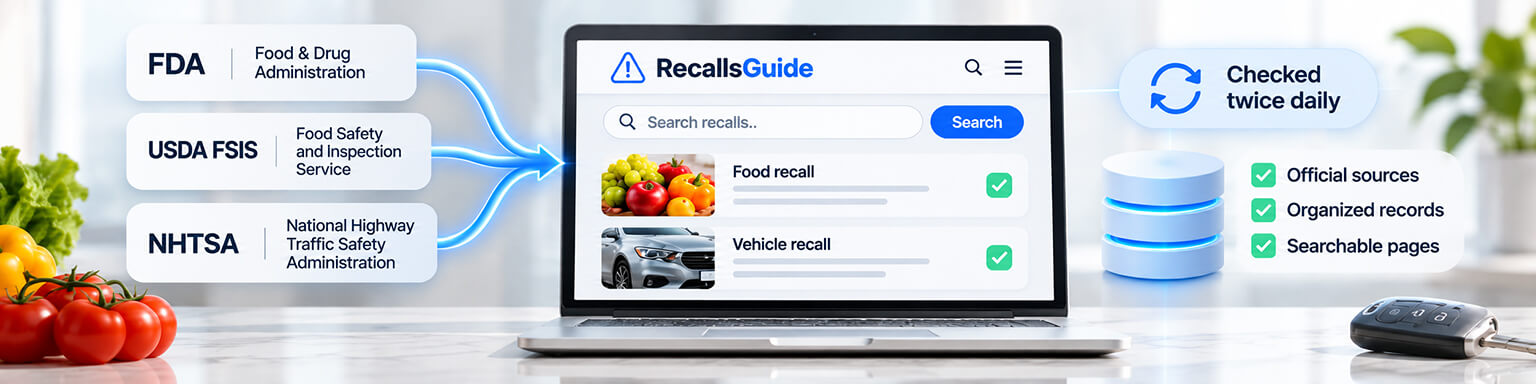
RecallsGuide collects official U.S. recall records from the Food and Drug Administration (FDA), the U.S. Department of Agriculture's Food Safety and Inspection Service (USDA FSIS) and the National Highway Traffic Safety Administration (NHTSA). We turn each record into a clear, searchable page. Our sources are checked twice a day. Every recall page links back to the official agency notice. We currently publish more than 25,000 recall pages covering food, vehicles, vehicle equipment, tires and child car seats.
Where our data comes from
Every recall on RecallsGuide comes from a U.S. government source. We do not accept recall information from manufacturers or users as a substitute for the official record.
| Area | Official source | What it covers | Coverage starts | Pages (Nov 2026) |
|---|---|---|---|---|
| Food (most foods, drinks, supplements) | FDA enforcement reports (openFDA), plus FDA company announcements | Recalls the FDA has classified | October 2021 | ≈ 6,300 |
| Meat, poultry and processed egg products | USDA Food Safety and Inspection Service | Recalls and public health alerts | January 2014 | ≈ 1,240 |
| Vehicles | NHTSA recalls data | Safety recalls by make, model and year | January 2006 | ≈ 16,000 |
| Vehicle equipment | NHTSA | Parts and accessories | January 2006 | ≈ 1,700 |
| Tires | NHTSA | Tire recalls | February 2006 | ≈ 260 |
| Child car seats | NHTSA | Car seat and booster recalls | September 2006 | ≈ 100 |
We also monitor official FDA and CDC food-safety announcements. These let us show a recall the day a company announces it, before the FDA's formal classification is published.
How often is RecallsGuide updated?
We check every source twice a day. A new recall usually appears on RecallsGuide within a day of the agency publishing it.
There is one important timing difference to understand. USDA and NHTSA publish recalls quickly, usually within a day of the recall starting. The FDA publishes its formal enforcement records weekly, and a classified FDA recall often appears there several weeks after the company first announced it. Where an official announcement exists earlier, we show it as a "Latest announcement" and link to it, so you are not waiting for the formal record.
What is on a recall page?
Each recall page brings together the details from the official record:
- What was recalled: product names, brands, sizes, and lot codes, UPCs or VINs where the agency provides them.
- Why: the hazard (for example Listeria, Salmonella, an undeclared allergen, or a vehicle defect) and the agency's description of the risk.
- How serious it is: the agency's classification (see section 5).
- Who and where: the recalling company and the distribution area.
- What to do: the action the agency or company recommends.
- Official source: a link to the original agency notice.
What the recall classes mean
The FDA and USDA classify food recalls by health risk:
- Class I: a reasonable probability that using the product will cause serious health problems or death.
- Class II: using the product may cause temporary or medically reversible health problems; the chance of serious problems is remote.
- Class III: using the product is unlikely to cause health problems, but it violates regulations.
USDA also issues public health alerts when a product may pose a risk but a recall is not possible (for example, when the product is no longer for sale). NHTSA vehicle recalls flag especially urgent cases, such as "Do not drive" and "Park outside" (fire risk) warnings. We show these prominently.
How we organise and label recalls
We sort recalls into hazard groups (such as Listeria, Salmonella, undeclared allergen or foreign material) using fixed, rule-based matching on the agency's own wording. Plain-language safety guidance on each page comes from a reviewed library written for each hazard type.
Recall pages are built directly from the official records. We do not use AI to decide what has been recalled, how serious a recall is, or what a page says about the risk.
How we check accuracy
- Each page is generated from the agency record and links to it, so you can always compare.
- Automated checks run against the live site to catch broken pages, missing data and formatting problems.
- When an agency updates or corrects a recall, our page updates at the next twice-daily check.
Limits and important notes
RecallsGuide is an independent website. We are not affiliated with, endorsed by, or acting on behalf of the FDA, USDA, NHTSA, CDC or any other government agency.
Always confirm with the official notice and the manufacturer before acting, especially for medical, allergy or vehicle-safety decisions. Agencies sometimes revise recalls after publication.
If you can't find a recall here, it may not be published by the agency yet (see section 3), or it may fall outside our coverage. We do not currently cover drugs, medical devices, cosmetics, pet food, or consumer products regulated by the Consumer Product Safety Commission (CPSC).
RecallsGuide does not provide medical or legal advice. If you think you are ill from a recalled food, contact a doctor.
Corrections
If you see an error, email support@recallsguide.com with the page link and what looks wrong. We check reported errors against the official record and correct confirmed mistakes promptly.
About RecallsGuide
RecallsGuide is run by Hoolaha LLC, based in Honolulu, Hawaii, USA. The site is funded by its founder. No company pays to have recalls included, removed or ranked.
Contact: support@recallsguide.com
Frequently asked questions
Is RecallsGuide an official government website?
No. RecallsGuide is an independent website that republishes official recall records from the FDA, USDA and NHTSA, with a link to the original notice on every page.
How current is the recall information?
We check our sources twice a day. USDA and NHTSA recalls usually appear within a day. FDA's formal records can appear several weeks after a company's announcement, so we also show official announcements as soon as they are published.
Why can't I find a recall I heard about?
It may not be published by the agency yet, especially for FDA food recalls, or it may be outside our coverage (we do not cover drugs, medical devices, cosmetics, pet food or CPSC consumer products). Check the agency's website, and email us if you think we've missed one.
What does a Class I recall mean?
A Class I recall is the most serious type. There is a reasonable probability that using the product will cause serious health problems or death.
How do I check whether my car has a recall?
Use our vehicle lookup by make, model and year, or by VIN. Always confirm open recalls with your dealer or at nhtsa.gov.
How do I get alerts about new recalls?
Sign up for RecallsGuide email alerts to hear about new food and vehicle recalls that match what you care about.
Questions or Feedback?
We're constantly working to improve our service. If you have suggestions, questions, or need help finding specific recall information, we'd love to hear from you.
Browse the recalls library · Check a vehicle by VIN · About RecallsGuide · Contact RecallsGuide